Ian Smith would be proud
Britain has faced this sort of constitutional crisis before.
On 11 November 1965, Ian Smith’s government in Rhodesia issued its Unilateral Declaration of Independence from Britain.
Now, 61 years later, Westminster faces another rebellion.
This time it is coming from Oxfordshire.
And, admittedly, the rebel territory is considerably smaller.
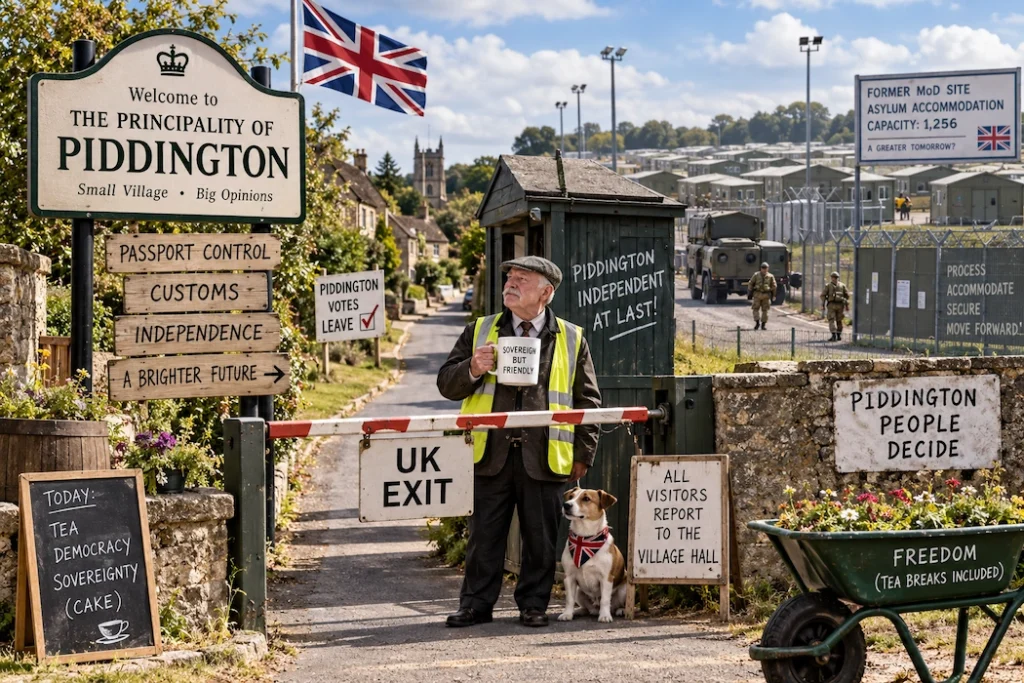
The village of Piddington has overwhelmingly voted to leave the United Kingdom in protest at government plans to accommodate up to 1,256 male asylum seekers at the nearby former MoD Bicester site. Of 312 votes cast in the village referendum, 285 were in favour of leaving the United Kingdom, 26 voted against and one ballot was spoiled.
One can only imagine the atmosphere in Whitehall.
Piddington has declared UDI.
Well, almost.
From Rhodesia to Piddington
When Ian Smith declared Rhodesian independence in 1965, Britain regarded the action as unconstitutional. It became an international political crisis that continued for years.
Piddington’s rebellion is rather less complicated.
Of course, nobody seriously believes that Piddington has become an independent country. That isn’t what makes this story interesting.
The interesting question is:
A Barracks Is Already a Small Community
The proposed accommodation is on a former military site. That matters.
Military barracks exist precisely because large numbers of people need to live together in an organised establishment. They provide accommodation, catering, administration and recreation. They can provide medical facilities, communications, transport, security and much of what is required for everyday life.
So why not use the site in that way?
I speak from personal experience.
When I joined the Army as a recruit, I spent 12 weeks in training during which I was not allowed out of barracks. I was a British citizen. I had not entered Britain illegally. I had committed no offence. I wasn’t in prison.
I was simply living within an establishment that had rules.
And that is the point.
Living within a controlled establishment for a limited period is hardly some revolutionary concept that Britain has never encountered before.
We have been doing it for generations.
So Run It Properly
If somebody has arrived in Britain without permission and is waiting for the authorities to determine whether they are entitled to remain here, accommodate them properly while that process takes place.
Give them decent accommodation. Feed them properly. Provide healthcare. Provide recreation and communications. Give them access to the officials dealing with their applications. And, most importantly, process those applications quickly.
But also have rules.
The establishment should be organised and controlled properly. Residents wishing to leave for the day could apply for a day pass. They check out when they leave. They check back in when they return.
Necessary journeys can be organised. Medical appointments, interviews and other legitimate requirements can be accommodated.
Comply with the rules and greater freedom can follow. Repeatedly disregard those rules and that freedom can become more restricted.
This doesn’t require some enormous new invention by Whitehall.
It requires organisation.
And perhaps an extraordinarily unfashionable word:
Responsibility.
Government Makes the Decision — Government Carries the Responsibility
This, to me, is where the argument becomes much bigger than Piddington.
Central government makes the immigration policy. Central government chooses the accommodation. Central government determines how many people will be housed there. Central government controls the resources.
So central government should also accept responsibility for making the arrangement work.
If the government decides that one establishment can accommodate more than three times the population of the neighbouring village, then the government should provide infrastructure proportionate to that decision.
It should not simply establish the accommodation and allow the consequences to spread into the surrounding community.
The people inside should be treated properly. But the people outside deserve consideration too.
Those two principles are not incompatible.
Look after the people awaiting a decision, but don’t make Piddington responsible for looking after the consequences of government policy.
Perhaps That Is What Piddington’s UDI Is Really About
Seen from this perspective, the referendum begins to look rather less like an argument about immigration alone. It becomes an argument about who carries responsibility when national policy arrives on somebody else’s doorstep.
The residents of Piddington cannot determine Britain’s immigration policy. They cannot decide who enters Britain. They cannot process asylum applications. They cannot determine who is entitled to remain. They cannot decide how many people the government accommodates at a former military establishment.
But they can make a noise.
And they certainly found an imaginative way of doing it.
They held a referendum. They counted the votes. And overwhelmingly, they voted to leave the United Kingdom.
Perhaps that is the message Westminster should pay attention to.
Not:
“We genuinely believe Piddington is about to become an independent sovereign state.”
But:
“Are you actually listening to us?”
The Principality of Piddington
For the moment, His Majesty’s Government can probably sleep peacefully.
Piddington is unlikely to apply for membership of the United Nations. The Bank of Piddington is unlikely to announce its first interest-rate decision. There seems little immediate need for customs posts on the roads into the village. And France is unlikely to recognise the new state before lunchtime.
But Westminster might nevertheless want to consider why an overwhelmingly large proportion of those voting in one small English village were prepared to participate in such an extraordinary protest.
Perhaps the answer isn’t particularly complicated.
If Britain wants large asylum reception centres, Britain should operate large asylum reception centres properly.
House people properly. Feed them properly. Process them quickly. Maintain proper control of the establishment. Provide the necessary infrastructure. And make central government responsible for the consequences of central government decisions.
Piddington should remain what it has always been:
a small English village.
Not the unofficial support infrastructure for a national immigration facility.
Perhaps if Westminster can manage that, diplomatic relations can finally be restored.
Ian Smith had Rhodesia.
Westminster now has the Principality of Piddington.
Fortunately, negotiations can probably still be conducted in the village hall.
And if all else fails, somebody can put the kettle on.
Threat level: Parish Council.


