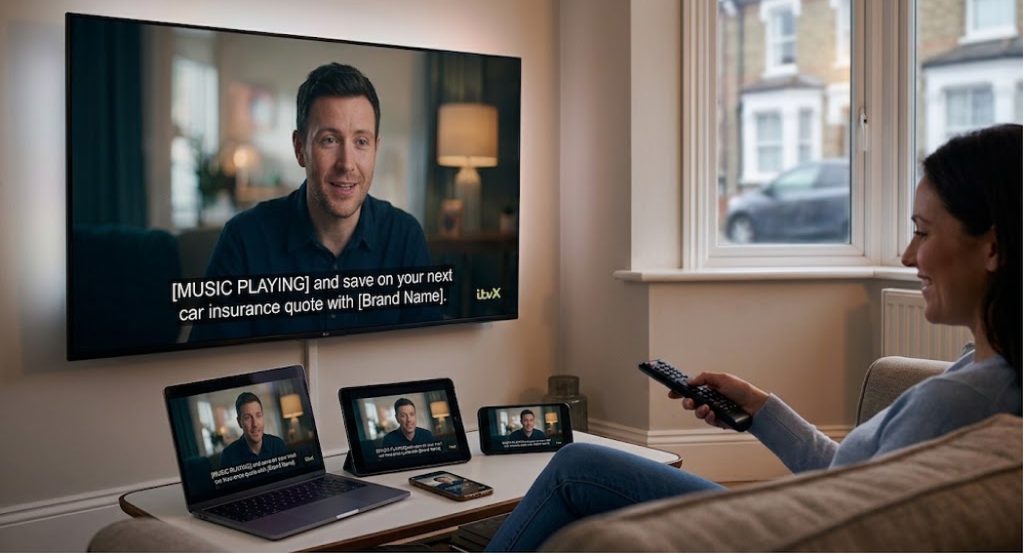
ITV has announced that from January 2027 closed-caption subtitling will become mandatory for all advertisers across its television channels and ITVX. The broadcaster, which works with around 2,000 advertisers, says reaching 100% subtitled advertising has been a long-term goal and has introduced a low-cost service to help smaller advertisers comply.
Will Every Film and TV Programme Eventually Have Subtitles?
It sounds like a relatively straightforward change to television advertising, designed to make commercials accessible to people who are deaf or have hearing loss. But it raises a considerably bigger question. If every television commercial should be available with subtitles, should every television programme be available with them as well? And if so, where does that requirement eventually stop?
What About Dramas and Films?
Suppose an ITV drama is interrupted by a commercial break. The drama is subtitled, the advertisements are subtitled and then the drama resumes with subtitles. From the viewer’s perspective, that is entirely logical. A person who depends upon subtitles doesn’t suddenly stop needing them because the programme has changed to an advertisement.
But reverse the argument. If ITV believes accessibility is important enough to insist that every advertisement it carries should be subtitled, surely the same argument applies even more strongly to the drama, documentary or film that somebody has specifically chosen to watch?
In fact, much of British television is already there. Ofcom’s television access-services rules require qualifying broadcasters to provide substantial levels of subtitling, signing and audio description. The requirements vary between broadcasters and services, so there is not currently a simple rule saying “every programme must have subtitles”. Nevertheless, subtitles are already an established part of mainstream television rather than an occasional additional service.
And What About the News?
News presents an especially interesting problem because much of it is live. A drama can be completed weeks or months before transmission and its subtitles can be prepared in advance. A breaking news bulletin cannot. Interviews are happening live, correspondents are reporting from different locations and presenters are reacting to events as they develop.
Yet live subtitling already exists. Broadcasters use techniques including speech recognition and human intervention to produce captions while programmes are being transmitted. Inevitably, that creates different challenges from subtitling a pre-recorded drama: delays, incorrect words and problems with names or rapidly changing stories can occur. The question therefore isn’t simply whether news should be subtitled, but how close broadcasters can get to making live television as accessible as recorded television.
Where Does the BBC Fit Into This?
The BBC makes the question even more interesting. It already has an extensive commitment to television accessibility and has historically targeted virtually complete subtitling across its principal television channels, including its news output. So it would be wrong to suggest that ITV’s advertising announcement suddenly puts the BBC under pressure to start subtitling its programmes — the BBC has been doing this on a very large scale for years.
The more interesting question is whether broadcasters including the BBC will increasingly extend the principle beyond traditional television. BBC content no longer lives only on BBC One, BBC Two or the BBC News channel. It appears through BBC iPlayer, websites, apps, social platforms and other digital formats. Ofcom is itself adapting regulation to a world in which the distinction between a television programme and online content is becoming less clear.
Streaming Is Already Moving in the Same Direction
The Media Act 2024 takes this considerably further. Major video-on-demand services designated as Tier 1 services will be brought within a statutory accessibility regime. The legislation ultimately sets a target under which at least 80% of catalogue hours must be subtitled, 10% audio-described and 5% signed, subject to the detailed framework and exemptions. The government announced in 2026 that major services with more than 500,000 UK users, including services such as Netflix, Amazon Prime Video and ITVX, would come within the enhanced Ofcom regulatory system.
Interestingly, the government has also stated that the framework is intended to be updated so that BBC UK video-on-demand services come within the new standards regime alongside other Tier 1 services. So this is no longer simply a question about traditional terrestrial television. Broadcast television and streaming are gradually being pulled towards the same accessibility principle.
So Will Every Film Eventually Have Subtitles?
Not necessarily — and certainly not as a consequence of ITV’s January 2027 advertising decision. There are exemptions, different requirements for different services and practical considerations surrounding the type of programme, technology and cost. An old film sitting in an archive presents a different problem from a newly commissioned television drama. A live regional news bulletin presents different challenges from a recorded documentary.
But perhaps the more important change isn’t whether the law eventually reaches 100%. It is whether audience expectation does. Once viewers become accustomed to subtitles being available on dramas, documentaries, films, news, streaming programmes and now every ITV advertisement, their absence becomes increasingly noticeable.
And Then Comes the Really Big Question
If subtitles become an expected part of television and streaming, why should the principle end there? A professionally produced documentary placed on YouTube is still a documentary. A news interview watched through a website is still a news interview. A film watched through an app is still the same film that might once have been watched on television.
The technology has changed enormously. What used to be a television set receiving a scheduled broadcast has become televisions, phones, tablets, computers, streaming services, websites and apps all delivering moving pictures to the same person. The viewer’s need for accessibility does not change according to which device happens to be showing the picture.
Perhaps the Question Is Changing
For many years the question surrounding a television programme or film might have been: “Does this need subtitles?” ITV’s decision to require them across all of its advertising is another indication that the question may gradually be reversing.
Drama already has extensive subtitling. News can be subtitled live. Major streaming services are moving into a statutory accessibility regime. ITV will require subtitles across all of its advertising from January 2027. The BBC already provides subtitles across an enormous proportion of its television output.
None of this means that Britain has introduced a rule requiring every piece of video to carry subtitles. It hasn’t. But the direction raises an intriguing possibility.
Perhaps we are approaching a point where the unusual thing will no longer be seeing subtitles on a film, television programme, news broadcast or advertisement.
The unusual thing will be finding one without them.


