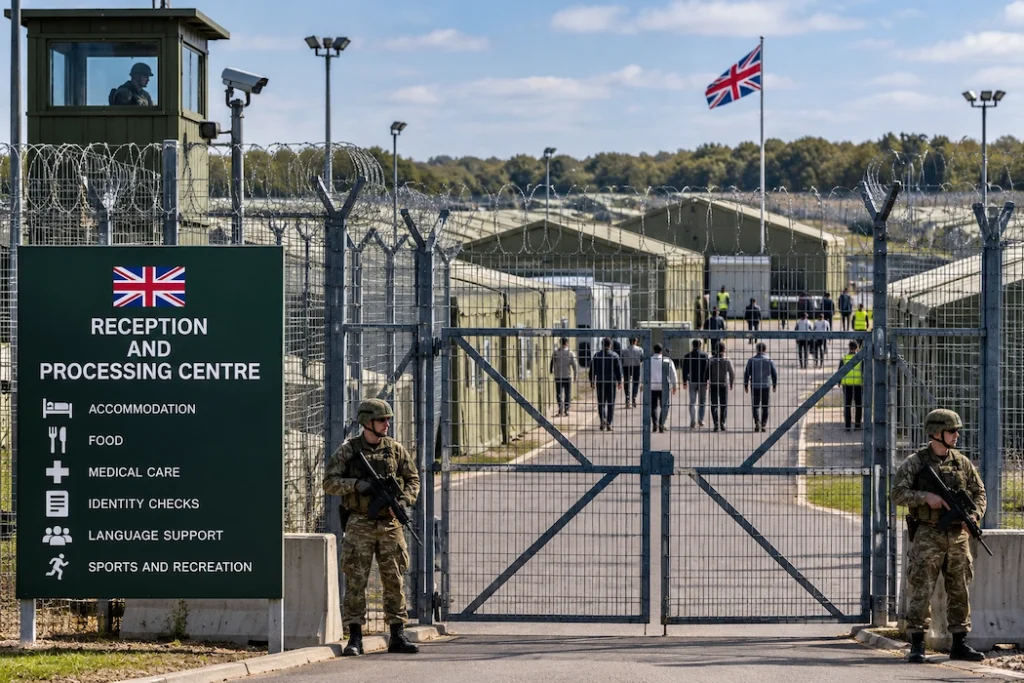
Protecting Britain’s Small Towns: Why Former Army Camps Should Be Considered for Immigration Reception
Should people arriving in Britain without permission be accommodated in secure, self-contained reception centres until initial immigration checks are completed, rather than being dispersed into small communities?
By T. G. Barker | TopNews23 | 22 October 2026
A Question of Responsibility, Not Hostility
Britain faces an important question concerning illegal immigration that deserves serious and practical discussion. When large numbers of people arrive in the country without prior immigration permission, should they be accommodated in small towns and communities before their identities and immigration circumstances have been properly established? Or should the government take direct responsibility for their initial reception, accommodation and screening in purpose-built or adapted facilities, including former military barracks?
This is not necessarily a question of whether those arriving are dangerous, nor should it be treated as an argument against people of different nationalities, cultures or religions. It is about the responsibility of government to protect the stability, resources and normal functioning of established communities while fulfilling its obligations to people seeking entry into Britain. Small towns should not be expected to carry a disproportionate burden created by national immigration policy.
The Impact on Small Communities
A small British town develops its infrastructure over many years around the needs of its established population. Its medical services, housing, public transport, policing, shops and community facilities are not designed to accommodate substantial and unexpected population increases. Consider a hypothetical town of 5,000 residents suddenly being required to accommodate 300 asylum seekers. That represents an additional population equivalent to 6% of the town’s existing residents. Even if every newcomer is entirely law-abiding, such a sudden concentration of people may place additional demands on services that are already stretched.
There are also questions of language, communication, cultural familiarity and integration. People arriving from different backgrounds may need time and support to understand British laws, institutions, expectations and customs. These differences do not automatically make anyone incompatible with British society. However, successful integration requires preparation, resources and consideration for the receiving community. The problem is not necessarily the character of the newcomers. It is the speed, concentration and management of their arrival.
Concerns about the distribution of asylum accommodation have been examined by Parliament, including the pressures that accommodation decisions can place on local services and community relations. These concerns raise a fundamental question: why should local communities bear the consequences of inadequate national planning?
An Alternative Already Exists: Former Military Barracks
Britain has a history of accommodating large numbers of people in military establishments. As someone who served in the British Army, I experienced the organisation and discipline of barrack life firsthand. During initial military training, recruits could be required to remain within the barracks until they had completed the appropriate stages of training. Accommodation, meals, medical attention, recreation and daily routines were organised within the establishment. Military service is legally different from civilian immigration detention, but the practical organisational principle is worth examining.
Why could suitable former military facilities not provide an organised initial reception system for people who arrive in Britain without immigration permission? Such facilities could provide:
- Accommodation and meals.
- Medical examinations and healthcare.
- Identity verification and immigration screening.
- Recreational and sporting facilities.
- English-language instruction and information about British laws and customs.
- Security, controlled access and professional supervision.
The purpose would not be punishment. It would be to create an orderly reception process in which the government, rather than an unprepared local community, assumes primary responsibility.
Secure Reception Rather Than Immediate Dispersal
The proposal goes beyond simply using former barracks as another form of accommodation. It asks whether people arriving without immigration permission should remain within a secure reception establishment during an initial period of identification and screening, rather than having unrestricted access to nearby communities. The objective is not to assume that arrivals are criminals or dangerous individuals. It is to avoid placing large groups of people into communities before the government has completed its initial responsibilities.
Under such a system, authorised staff would conduct identity and security checks, assess immigration circumstances, identify vulnerabilities and determine the next appropriate steps. The facilities could be supervised by trained security personnel, with military assistance where legally authorised. Residents would receive proper food, healthcare, accommodation and recreation, with their treatment subject to independent oversight. The question of how long someone could lawfully be required to remain would need clear rules, regular review and safeguards against indefinite detention. This is an important distinction between a controlled reception system and imprisonment without a defined legal process.
What Is Britain Already Doing?
The government has already recognised the potential of former military establishments. Sites such as Wethersfield in Essex have been used to accommodate asylum seekers, and other former military locations have been considered for similar purposes. The Home Office has described such facilities as largely self-contained, with essential services provided on site to reduce pressure on surrounding communities. However, these accommodation arrangements are generally non-detained, meaning residents are permitted to leave.
The proposal being considered here is different: whether a defined period of secure initial reception should precede unrestricted movement into local communities. That would require Parliament to consider the legal basis for detention, the circumstances in which it would be justified, its duration and the rights of those affected. Existing legislation and human-rights obligations cannot simply be ignored, but legislation can be debated and amended through Parliament where changes are considered necessary and lawful. The relevant policy question is whether such a system could be justified, operated humanely and shown to reduce the pressures experienced by local communities.
Protecting Communities Is Not the Same as Rejecting Immigration
It is important to distinguish immigration itself from the way immigration is managed. People have moved to Britain from other countries for generations, contributing to its economy, institutions and society. Many people who arrive irregularly also have asylum claims that must be examined under British law. But recognising those facts does not eliminate the government’s responsibility to manage arrivals properly.
A community should be able to expect that decisions affecting its population, infrastructure and social environment are made transparently, with meaningful consultation and consideration of local capacity. It is not unreasonable for residents to ask whether their GP surgeries, housing, transport and public services can accommodate substantial additional demand, nor should raising these questions automatically be interpreted as hostility towards foreigners. The central issue is the responsibility of the state.
Who Should Carry the Burden?
Immigration policy is determined nationally. Border controls, asylum decisions, immigration enforcement and the management of arrivals are responsibilities of central government. Yet the practical consequences of accommodation decisions can fall heavily upon individual towns and neighbourhoods. This creates an imbalance: national government makes the decisions, while local communities experience the immediate consequences.
A reception system based on suitable former military facilities could offer an alternative, although its cost, capacity, legal requirements and effects on neighbouring communities would need careful assessment. It would not remove the need for eventual community accommodation for those entitled to remain, nor would it eliminate the need for properly funded integration. But it could provide an organised initial stage before dispersal decisions are made.
A Principle Worth Establishing
The debate should begin with a straightforward principle: the responsibility for receiving, accommodating and initially processing people who enter Britain without permission should rest with the national government, without imposing disproportionate social, financial or infrastructure burdens on established local communities.
From that principle, several practical questions follow. Could former military establishments provide suitable reception facilities? Could essential services be delivered on site? Could initial identity and immigration checks be completed more efficiently? What lawful restrictions on movement would be justified? And could such arrangements reduce the pressures placed upon small towns? These questions deserve detailed consideration rather than dismissal.
Britain has the administrative experience, military infrastructure and institutional resources to examine alternative arrangements. Whether secure reception centres would prove more effective, economical and legally sustainable than existing accommodation arrangements is a matter for evidence and parliamentary scrutiny.
Conclusion: The Rights of Communities Matter Too
A responsible immigration system must recognise obligations in two directions. It must treat people arriving in Britain humanely and fairly, while also recognising the legitimate interests of the communities expected to accommodate them. These responsibilities should not be presented as mutually exclusive. Former military facilities offer one possible way of providing organised initial reception, essential services and screening while reducing immediate demands on local towns. The difficult question of compulsory confinement would still require a clear legal justification, defined limits and independent safeguards.
But the wider principle remains: small British towns should not be expected to absorb the consequences of national immigration decisions without adequate preparation, infrastructure, consultation and protection of their existing community life. That is not an argument against immigration. It is an argument for government accountability.


