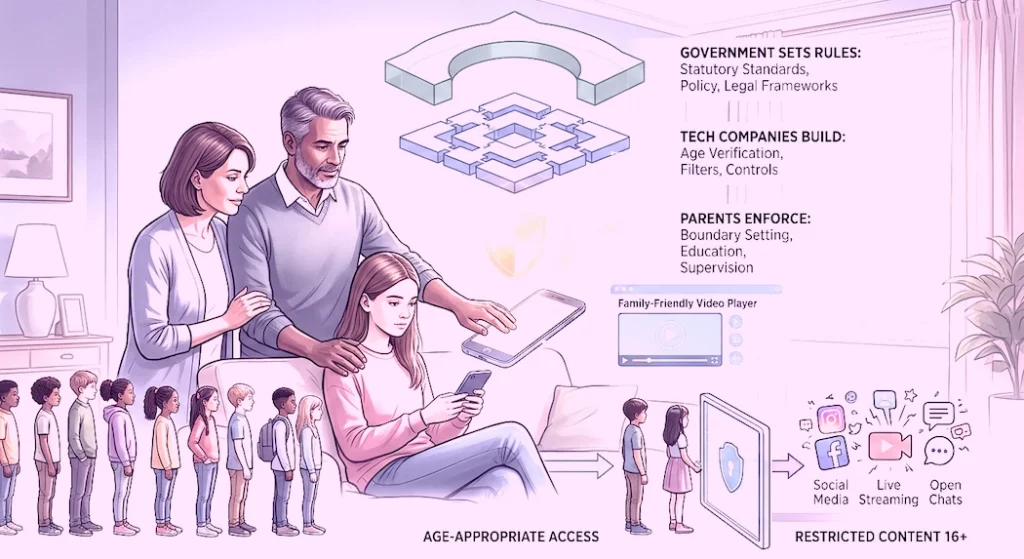
Why Legislation Cannot Replace the Parent
Government should set the rules. Technology companies should provide the safeguards. Parents should enforce those safeguards.
The debate over the relationship between minors and the internet has fundamentally shifted from a question of if the state should intervene to how. Following a comprehensive national consultation that revealed an overwhelming mandate from the British public, the UK government announced plans to introduce a statutory ban on social media access for children under the age of 16. Implemented via secondary legislation through amendments to the Online Safety Act, this landmark policy—mirroring similar legislative efforts in Australia—represents a profound “line in the sand.” Under-16s will soon be legally restricted from accessing algorithmic, user-to-user platforms such as TikTok, Instagram, and Snapchat, while high-risk structural features like live-streaming and unregulated adult-to-child communication will face stringent curbs.
This policy shift has been widely celebrated, particularly by grassroots coalitions like the Smartphone Free Childhood movement, which has mobilised hundreds of thousands of parents across the United Kingdom. To many, the state is finally stepping in to correct a market failure that has, for nearly two decades, treated a generation of young people as an unregulated psychological experiment.
Yet, as the dust settles on this legislative victory, an uncomfortable truth emerges: a statutory ban is only as strong as its domestic enforcement. Public discourse has a habit of treating state regulation as a panacea, operating under the assumption that once an Act of Parliament is passed, the problem is solved. In reality, the looming restrictions will test the boundaries of public enforcement. Government should undoubtedly set the baseline rules, and technology companies must build the technical safeguards to comply with them. But if these laws are to meaningfully protect young people, parents must remain the primary enforcers of those safeguards. The family home, not the regulator’s office, remains the first line of defence.
The Precedent of the Physical World
To understand why the digital realm requires a synthesis of state rule-making and parental enforcement, one needs only to look at how British society regulates the physical world. We do not live in a libertarian vacuum where parents are left entirely to their own devices, nor do we live in an authoritarian state where police officers tuck children into bed. Instead, we rely on a delicate framework of shared responsibility.
Consider the legal architecture surrounding youth and public safety in the UK:
- Education: The law dictates that children must receive a full-time education up to the age of 16. However, the state does not enter millions of homes every morning to pull children out of bed. It is the legal duty of the parent to ensure school attendance, and failure to do so results in parental fines or prosecution.
- Controlled Substances: The state sets the legal age for purchasing alcohol, tobacco, and vaping products at 18. It enforces these limits at the point of sale via trading standards and initiatives like Challenge 25. Yet, society explicitly expects parents to supervise what happens behind closed doors, guiding children through the dangers of substance abuse and monitoring their social circles.
- Criminal Conduct: If a minor engages in anti-social or criminal behaviour, the legal system holds the parents explicitly accountable, often through parental compounding or youth offending interventions that require parental participation.
In every offline scenario, the state establishes the perimeter, and the commercial sector is forced to respect it. But the daily monitoring—the boundary-setting, the difficult conversations, and the ultimate accountability—rests squarely with the family.
The digital world should be treated no differently. It is a logical fallacy to argue that because an environment is rendered in pixels rather than bricks and mortar, the fundamental duty of parental supervision evaporates. If a parent would not leave their 13-year-old unaccompanied in a crowded pub, a casino, or a convention centre filled with unvetted strangers, they cannot logically justify allowing that same child to wander unsupervised through the digital equivalents of those spaces.
The Smartphone as an Unrestricted Gateway
The primary obstacle to effective supervision is the nature of the modern smartphone. It is frequently mischaracterised as a mere communication tool—a digital upgrade to the landline or the basic mobile phone of the early 2000s. In reality, a smartphone is a highly sophisticated, unmonitored gateway to an entire ecosystem of adult environments.
When a child is handed a standard smartphone, they are not just given a way to call home after football practice. They are granted friction-free access to:
- Algorithmic Social Media (TikTok, Instagram, Snapchat)
- Encrypted Messaging Services & Public Channels
- Global Video Platforms & Uncurated Livestreams
- Immersive Gaming Communities with Open Voice Chat
- Targeted Predatory Advertising Networks
- Unrestricted Web Content & Algorithmic Echo Chambers
This structural complexity means that modern parents have an escalated duty of care. It is no longer sufficient to ask a child how their day was at school; parents must take an active, granular interest in what their children are doing online. This does not imply an authoritarian surveillance state within the home, but it does require an active, engaged curiosity. Understanding which platforms a child uses, recognizing the mechanics of the algorithms that feed them content, and monitoring the direct messaging features of seemingly innocent video games are now core tenets of modern parenting.
The Danger of Total Externalisation
The recent trajectory of the public debate surrounding online safety has highlighted a troubling trend: the total externalisation of blame. Whenever a tragedy occurs, or a study links prolonged screen time to a spike in adolescent anxiety and depression, the focus shifts entirely to technology executives and regulatory bodies like Ofcom.
While Big Tech undoubtedly deserves fierce criticism for designing deliberately addictive interfaces and failing to police harmful material, placing blame solely on corporate actors creates a moral hazard. It risks undermining parental responsibility by cultivating the dangerous illusion that tech companies or government inspectors can completely insulate a child from harm.
If parents come to believe that highly effective age assurance (HEAA) systems or state-mandated firewalls have rendered the internet entirely safe, they will naturally lower their guard. This externalisation disempowers parents, transforming them from active guardians into passive observers of their children’s digital lives.
No regulator, no matter how well-resourced, can sit on a teenager’s bed at 11:00 PM to ensure they have not bypassed a router filter. No corporate algorithm, no matter how sophisticated, can assess whether a specific piece of content is triggering an individual child’s unique psychological vulnerabilities. By over-promising what state regulation can achieve on its own, we inadvertently encourage parental abdication.
The Limits of Technical Safeguards
A critical assessment of age-verification mechanisms and parental control software reveals that technical barriers are inherently porous. The impending UK ban intends to rely on advanced age-assurance methods that go significantly beyond self-declaration—including third-party identity verification and device-based signals. Yet, history tells us that teenagers are remarkably adept at circumventing technical restrictions.
Whether through the deployment of Virtual Private Networks (VPNs), the creation of secondary “finsta” accounts, using older siblings’ credentials, or exploiting structural loopholes in device operating systems, children frequently outpace both their parents and platform developers in technical agility.
| Shield Type | Technical Mechanism | Vulnerability / Bypass Method |
|---|---|---|
| Age Assurance | Third-party identity checks, facial age estimation, or credit card verification. | Using parental documentation, borrowing older peers’ accounts, or utilising unverified alternative platforms. |
| Network Filters | Router-level blocks on specific URLs and content categories. | Switching from home Wi-Fi to cellular data, using public hotspots, or routing traffic through a encrypted VPN. |
| On-Device Controls | Screen-time limits and app restrictions via software like Apple Screen Time or Google Family Link. | Factory-resetting secondary devices, manipulating time-zone settings, or utilizing built-in browser loopholes within third-party apps. |
Because technical shields are prone to failure, they can never serve as a substitute for engaged parenting. A parental control app can flag that a child spent four hours on an encrypted messaging platform, but it cannot hold the conversation that explains why a toxic online community is damaging their self-worth.
The most effective form of protection remains relational, not digital. It is built on a foundation of open communication, clear boundaries, and consistent offline enforcement. A child who respects their parent’s rules and understands the rationale behind them is far less likely to spend their evenings researching ways to subvert a digital firewall.
Reclaiming the “Smartphone-Free Childhood”
A collateral benefit of stronger parental responsibility is the structural leverage it provides to the consumer market. When parents collectively refuse to surrender their authority to the digital status quo, they alter market incentives. We are already seeing the early stages of this shift through the rise of the “Parent Pact” initiatives, where entire school cohorts of parents pledge to delay smartphones until a certain age.
This collective parental stance is beginning to stimulate the development and adoption of age-appropriate mobile devices for younger teenagers. Instead of choosing between total digital isolation and giving a child a smartphone with unrestricted web access, parents are demanding a third way:
The Intermediate Device: Mobile devices designed explicitly for younger teenagers that offer essential utility—GPS tracking, voice calls, and basic text messaging—whilst structurally omitting internet browsers, algorithmic social media feeds, and app stores.
By embracing these alternative technologies, parents can successfully navigate the peer-pressure trap. The argument that “everyone else has one” loses its potency when communities of parents stand together to redefine what is normal. This is parental enforcement at its most creative and effective: using parental authority to shape a safer, slower transition into adulthood, rather than passively accepting the consumer choices dictated by Silicon Valley.
Supporting, Not Replacing, the Family
Anxieties regarding a parent-led model of enforcement are understandable and deserve a fair hearing. Critics frequently point out that many parents lack the technical literacy to configure complex router settings or audit a smartphone’s privacy logs. Others note that in an era defined by economic pressures, many families—particularly single parents or those working multiple jobs—lack the time, energy, or emotional resources to constantly police screen time. Furthermore, vulnerable children living in unstable domestic environments cannot rely on parental protection, leaving them exposed if the state does not step in.
These are legitimate challenges, but they do not negate the fundamental principle of parental responsibility. Instead, they clarify what the role of the state should be. The government’s mandate should not be to replace the parent, but to support them.
Instead of treating parents as obsolete, the state should use its regulatory power to make parental enforcement realistic and accessible:
- Mandated Simplicity: Regulators should compel device manufacturers and software developers to make parental controls intuitive, standardized, and enabled by default, removing the technical barrier to entry for non-technical parents.
- Public Health Literacy: Governments should invest in sustained public health campaigns—similar to historical initiatives on smoking or childhood nutrition—that educate parents on the cognitive impacts of algorithmic media.
- Targeted Social Interventions: For vulnerable children lacking domestic support, schools and social services must act as a targeted safety net, without using those exceptional cases to justify stripping accountability from the wider population.
Conclusion: The First Line of Defence
The impending legislative restrictions on social media for under-16s represent a historic victory for child welfare in the United Kingdom. It is a necessary intervention that fixes a broken market, forces technology companies to implement robust age assurance, and establishes a clear legal standard for what is appropriate for a developing mind.
However, a statutory framework can only ever build the fence; it cannot guard the gate. The digital world is inherently intimate, pervasive, and domestic. It bypasses public squares and enters the privacy of the bedroom, operating at all hours of the night. No state regulator can or should police that space.
If we wish to protect our children from the documented harms of algorithmic exploitation, cyberbullying, and inappropriate content, we must resist the temptation to outsource our responsibilities to the state or to corporate algorithms. The family home must remain the first line of defence. Government can write the regulations, and technology companies can build the safeguards, but it is ultimately the presence of an engaged, informed, and authoritative parent that will ensure those safeguards mean something in the life of a child. Protecting childhood in the digital age requires state action—but it begins at the kitchen table.


