For digital publishers and news platforms, the formula for growth has always seemed simple: publish at volume. You cover the trending stories, push out daily content, and watch your overall search traffic climb.
Why High-Volume News Sites Stop Ranking
On the surface, a rapidly expanding archive looks like a success story. But for high-velocity media sites, a hidden structural trap is constantly waiting.
The site’s content generation vastly outpaces what its navigation menu can handle.
While a typical news homepage or navigation bar can only highlight a few dozen featured stories and core categories, a prolific media site will generate thousands of articles a year. When your daily publishing volume eclipses the system built to display it, content begins to decay.
This raises a massive algorithmic question: If your main navigation cannot possibly link to thousands of past stories, how does Google determine which of your news archives still deserve traffic?
The answer requires a complete shift in how digital newsrooms think about site structure.
The Editorial Illusion: Sitemaps vs. Real Equity
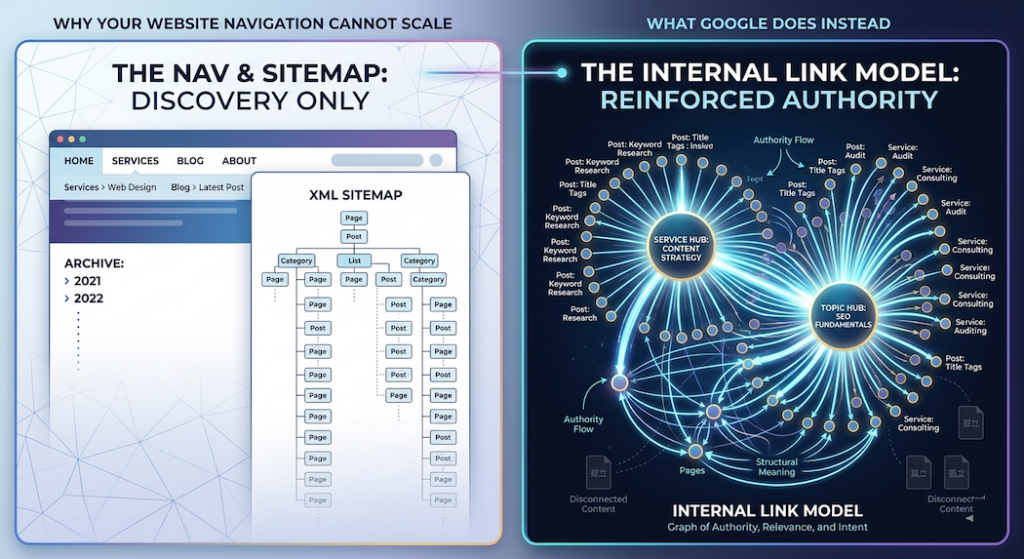
Many editorial teams assume that Google News feeds and XML sitemaps completely solve the indexation problem. Because your sitemap pings search engines the second a new article goes live, it is easy to assume Google fully understands the value of that piece. Unfortunately, it doesn’t.
The Media Blindspot:
- Sitemaps & RSS Feeds are discovery tools. They tell Google a breaking story exists today.
- Internal Links are valuation tools. They tell Google if an older article deserves recurring, long-tail traffic tomorrow.
A breaking news piece that relies solely on a sitemap or a temporary homepage feature will spike in traffic for 48 hours. But once it drops off the homepage, it becomes structurally isolated. It enters the deep abyss of pagination, contributing nothing to the site’s overall authority and drawing zero passive search traffic.
The Decay Rate of High-Volume Publishing
Let’s look at how quickly a media platform outgrows its own frame. If a news site pushes just 5 articles a day, the structural scale shifts dramatically:
| Timeline | Total Articles Published | Navigation Visibility |
|---|---|---|
| End of Week 1 | 35 Articles | Visible on Homepage / Recents |
| End of Month 3 | ~450 Articles | Pushed to Page 15+ of Archives |
| End of Year 1 | ~1,800+ Articles | Buried deep in the database |
From an editorial perspective, you have built a massive library of information. But from Google’s perspective, over 95% of those pages have become functionally invisible, disconnected from the core structural pathways of your domain.
This is where media sites hit a traffic plateau. Content quality hasn’t dropped, but the site has become an unnavigable graveyard of unlinked text.
How Google Evaluates a Fast-Moving Graph
Google doesn’t look at a news site as a chronological list of blog posts. Modern search systems view your platform as an interconnected network of relationships.
To crawl massive sites efficiently, Google constructs a probabilistic model of your domain based on:
- Topical Continuity: Do your daily stories consistently reinforce core pillars?
- Contextual Links: How naturally do your new stories pass authority back to older, foundational reports?
- Intent Pathways: Can a user naturally navigate from a breaking headline into the broader context of that topic?
[ Today's Breaking News ] ───> (Internal Link) ───> [ Evergreen Topic Hub / Category ]
                                                            │
[ Yesterday's Follow-up ] ───> (Internal Link) ───────┘
When thousands of fast-moving articles treat the site as a web—consistently passing authority backward and laterally—the entire domain’s search equity rises. If they don’t, individual articles rank briefly and die permanently.
The Solution: Treating Categories as Dynamic Topic Hubs
Because a news site cannot feature every article in its main menu, your category and tag pages must transform from passive archives into dynamic “Topic Hubs.”
Instead of allowing an article to simply drop off the homepage into page 40 of a generic “Tech” category, sophisticated publishers utilize a Hub-and-Spoke internal linking framework inside the body copy itself.
When a fresh story breaks, the editorial workflow shouldn’t stop at hitting “Publish.” The content must actively anchor itself into the site’s permanent infrastructure by satisfying three content-routing rules:
- Rule 1: Anchor Upward to the Parent Hub. Every trending story must explicitly link back to a permanent, high-value pillar page or dynamic category hub using descriptive anchor text.
- Rule 2: Weave Laterally into Context. Link the new article to at least two older, highly relevant background pieces to keep users on-site and pass fresh crawl equity to older URLs.
- Rule 3: Update the Permanent Archives. Go back to the core reference page for that ongoing topic and drop a link forward to the new breaking update, ensuring Google’s crawler finds it from a high-authority node.
The Verdict for TopNews23
In the fast-paced world of digital media, visibility is not automatically granted just because you keep writing. Visibility emerges from structure.
Google doesn’t just rank individual articles; it continuously refines its internal interpretation of your entire platform. The main navigation menu is simply the front door. The real engine driving your long-term organic traffic is the internal link network connecting your breaking news to your evergreen foundation.
Turn your publishing volume into structural authority, and your traffic will scale alongside your content archive.


