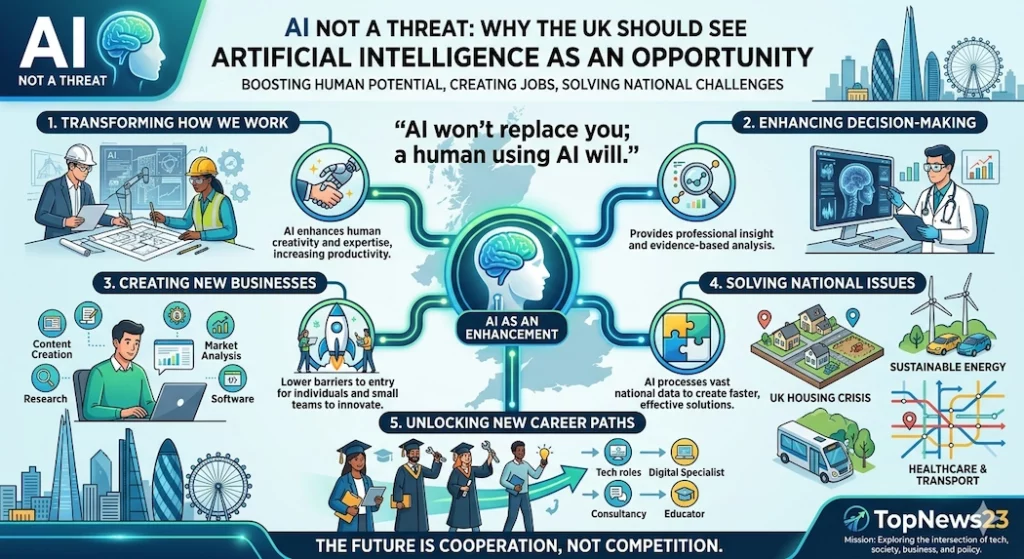
Artificial Intelligence has become one of the most debated subjects in Britain. Hardly a week passes without headlines warning that AI will replace workers, eliminate careers, and fundamentally change the employment landscape. Students worry about whether there will be jobs available when they graduate. Employees wonder whether the technology sitting on their computer screens today may eventually replace them tomorrow.
The fear is understandable. Every major technological shift throughout history has created uncertainty. However, there is another side to this conversation that receives far less attention. Instead of viewing AI solely as a threat, Britain should begin looking at how artificial intelligence can enhance human capability, create new opportunities, solve longstanding national problems, and even enable ordinary individuals to build businesses that would have been impossible just a few years ago.
1. The Anatomy of AI Anxiety
Fear often emerges when people encounter something powerful that they do not fully understand. Artificial intelligence can write reports, analyse data, generate images, answer questions, create software code, and perform tasks that previously required human effort. To many workers, it appears that a machine is beginning to perform parts of their job.
This fear is amplified by media headlines that frequently focus on layoffs, automation, and corporate investment in AI technologies. For a university student preparing to enter the workforce or an employee who has spent years developing specialist skills, the prospect of being replaced can feel deeply unsettling.
The concern is real because AI is not simply another software tool. It represents a significant change in how information is processed and how decisions can be supported by technology.
AI won’t replace you; a human using AI will.
2. Why the Fear Is Understandable
The anxiety surrounding AI should not be dismissed. Throughout history, technological revolutions have disrupted industries and changed the nature of work.
The Industrial Revolution transformed manufacturing. Computers transformed offices. The internet transformed communication, retail, media, and marketing. Each innovation created winners and losers. Entire professions evolved or disappeared while new industries emerged.
Artificial intelligence is likely to follow a similar path. Certain repetitive tasks will undoubtedly become automated. Some jobs will require fewer people than before. Certain skill sets may become less valuable while entirely new specialisations emerge.
Workers are therefore justified in asking difficult questions. How will their role change? What new skills will be required? How can they remain relevant in a rapidly changing economy?
These concerns deserve serious discussion. However, fear alone is not a strategy.
3. From ATMs to PCs: How Innovation Redefines Work
When personal computers arrived in offices, many people predicted widespread unemployment. Instead, computers created entirely new professions, from software developers and IT support engineers to digital marketers, cybersecurity specialists, and web designers.
The internet produced similar fears. Yet millions of jobs were ultimately created through e-commerce, digital publishing, social media, online education, and countless other sectors.
Artificial intelligence appears to be following the same pattern. Rather than replacing all workers, it is changing the way work is performed.
A solicitor may use AI to review documents faster. An architect may use AI to analyse design options. A marketer may use AI to generate content ideas. A doctor may use AI to identify patterns within medical data.
In each case, the professional remains essential. The technology simply increases productivity and enables more informed decisions.
The most successful individuals are unlikely to be those who compete against AI. They will be those who learn to work alongside it.
4. How Ordinary People Can Use AI Today for Free
One of the most remarkable aspects of the current AI revolution is that many of the tools are available to anyone with an internet connection.
Platforms such as ChatGPT, Gemini, Claude, and other large language models allow users to ask questions, analyse information, generate ideas, and explore opportunities without spending money.
A job seeker can use AI to improve a CV. A student can use AI to explain difficult concepts. A small business owner can use AI to draft marketing plans. A writer can use AI to research topics. A retiree can use AI to learn new skills or investigate business ideas.
The barrier to entry has never been lower.
The challenge is not access to the technology. The challenge is curiosity. Those willing to ask questions, experiment, and explore will often discover opportunities that others overlook.
5. How AI Could Help Solve Major UK Problems
Perhaps the greatest opportunity lies not in replacing workers but in solving problems that have frustrated governments and communities for decades.
Take housing as an example.
Britain faces a chronic housing shortage. Delivering millions of new homes requires consideration of infrastructure, utilities, transport links, environmental constraints, planning regulations, demographics, employment centres, and construction resources.
An AI system could analyse vast quantities of national data far more quickly than traditional approaches. It could identify potential development sites, assess infrastructure requirements, model population growth, estimate costs, and highlight areas where housing projects could proceed efficiently.
The same principle applies to healthcare, transport, education, social care, energy planning, and environmental management.
Artificial intelligence does not replace civil engineers, planners, healthcare professionals, or policymakers. Instead, it provides them with enhanced analytical capabilities, enabling more informed and evidence-based decisions.
Used correctly, AI could become one of the most powerful problem-solving tools available to modern government.
6. How Individuals Can Create New Businesses Using AI
Many people focus exclusively on the jobs AI may affect. Far fewer consider the businesses AI can help create.
Today, a single individual can launch a website, conduct market research, generate content, develop software prototypes, analyse competitors, create marketing campaigns, and reach global audiences with the assistance of AI tools.
Tasks that once required multiple employees and significant investment can now be accomplished by small teams or even individuals.
This creates opportunities for entrepreneurs, freelancers, consultants, educators, and creators.
A person with industry expertise can combine that knowledge with AI assistance to build products and services more quickly than ever before.
The technology itself is not the business opportunity. The opportunity lies in applying AI to solve real-world problems that people are willing to pay to have solved.
7. The Biggest Risk May Be Failing to Learn How to Use AI
The greatest danger may not be artificial intelligence itself.
The greater risk may be ignoring it.
Throughout history, those who adapted to new technologies generally prospered. Those who refused to engage often found themselves at a disadvantage.
Artificial intelligence is unlikely to eliminate the need for human creativity, judgement, empathy, leadership, and expertise. What it will do is amplify the capabilities of those who learn to use it effectively.
The individuals, businesses, and nations that embrace AI responsibly are likely to gain significant advantages over those that resist change.
Britain has an opportunity to lead in this area. Instead of asking whether AI will take jobs, perhaps the more important question is this:
How can we use AI to create better jobs, build better businesses, and solve some of the country’s most pressing challenges?
The answer to that question may determine whether artificial intelligence becomes a source of fear or one of the greatest opportunities of our generation.
About TopNews23
TopNews23 explores the intersection of technology, society, business, science, and public policy. Our goal is to examine emerging developments such as Artificial Intelligence and understand how they can be applied to improve lives, strengthen communities, and solve real-world challenges.
“`


