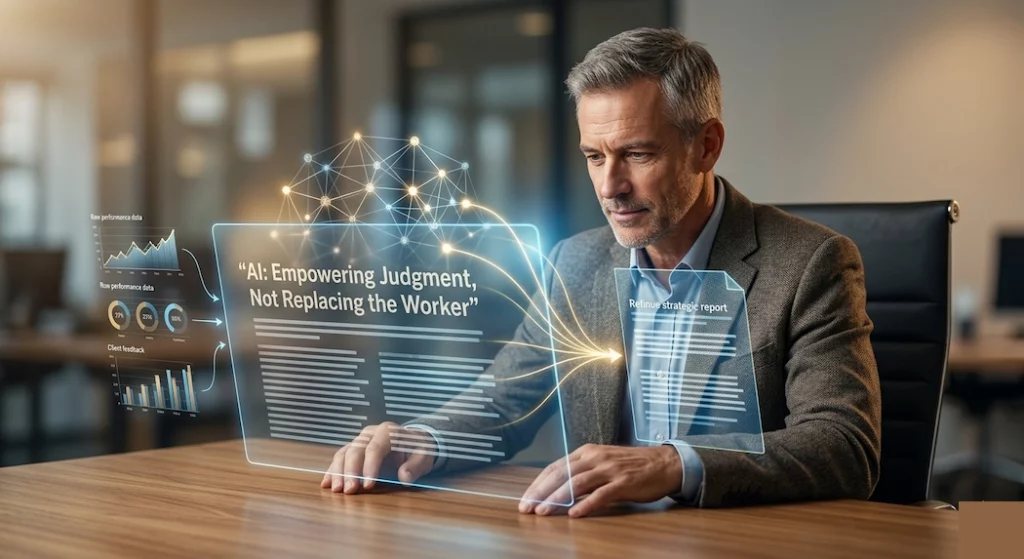
The Real AI Debate Is Not About Technology — It’s About People
If you’ve spent any time in the workplace over the past two years, you’ll know one thing for certain: AI has arrived, and it didn’t bother knocking. It’s in our inboxes, our meetings, our workflows, and—if we’re honest—our anxieties. For some, it’s the shiny new colleague who never sleeps and always has a suggestion. For others, it’s the ominous shadow in the corner, whispering about job losses and automation. But here’s the truth we’re all quietly grappling with: AI isn’t just a technological shift; it’s an emotional one. And whenever emotions enter the workplace, leaders have a responsibility to get the conversation right.
So, will AI replace workers or empower them? The answer depends far less on the technology itself and far more on how organisations choose to use it.
The Fear Is Real — and Leaders Shouldn’t Dismiss It
People are worried. Not because they’re resistant to change, but because they’ve lived through enough “transformations” to know that sometimes the people get transformed right out of the organisation. When employees hear “AI will make us more efficient,” what they often feel is “my job is on the line.” You can’t logic someone out of a fear they didn’t logic themselves into. You have to acknowledge it, sit with it, and then help them see the opportunity on the other side.
AI isn’t the first workplace disruptor. We’ve been here before with automation, outsourcing, cloud computing, and even email. The organisations that thrived were the ones that treated people as partners in the change, not passengers.
AI Won’t Replace Workers — But Workers Who Use AI Will Replace Those Who Don’t
AI isn’t coming for jobs; it’s coming for tasks. Most roles are a bundle of responsibilities—some meaningful, some mundane. AI is exceptionally good at the mundane, and far less capable at the human stuff: empathy, judgement, creativity, leadership, humour, and navigating the messy emotional reality of working with other humans.
If AI can take the admin, the repetition, the copy‑and‑paste, the “why am I doing this at 5pm on a Friday?” tasks, then people can focus on the work that actually moves the needle. The organisations that win won’t be the ones that replace people with AI. They’ll be the ones that equip people with AI.
The Real Opportunity: A More Human Workplace
AI isn’t just a productivity tool; it’s a chance to redesign work so it’s more human, not less. Imagine a world where managers spend less time reporting and more time coaching; customer service teams spend less time searching for answers and more time building relationships; HR teams spend less time processing forms and more time supporting people; analysts spend less time wrangling spreadsheets and more time interpreting insights; and creatives spend less time formatting and more time imagining.
AI can’t replace the spark that makes people brilliant. But it can remove the friction that stops them getting there.
But Empowerment Doesn’t Happen by Accident
AI won’t magically empower people just because you’ve rolled out a new tool and sent a link to a training video. Empowerment is a cultural choice. There are three things organisations must get right:
1. Transparency
People don’t fear AI; they fear surprises. Tell them what you’re doing, why you’re doing it, and how it affects them. Silence breeds stories, and stories breed fear.
2. Training
You wouldn’t hand someone a forklift and say “have a go.” AI is no different. People need time, space, and psychological safety to learn. Training isn’t a one‑off workshop; it’s a shift in mindset.
3. Trust
If you introduce AI as a surveillance tool or a way to squeeze more output from fewer people, you’ll break trust faster than any algorithm can repair it. But if you introduce AI as a partner—something that helps people do their best work—you unlock engagement most organisations only dream of.
Leaders Need to Model the Behaviour They Want to See
If leaders aren’t using AI, employees won’t either. If leaders treat AI as a threat, employees will too. But if leaders show curiosity, humility, and a willingness to learn, it sets the tone. One of the most powerful things a leader can say right now is: “I don’t know everything about AI, but I’m learning—and I want us to learn together.” That’s not weakness. That’s leadership.
The Future of Work Isn’t AI vs Humans — It’s AI with Humans
The organisations that thrive in the next decade will be the ones that understand a simple truth: technology doesn’t create competitive advantage; people do. AI is just the amplifier. Give a disengaged team AI and you’ll get faster disengagement. Give a curious, supported, empowered team AI and you’ll get innovation.
AI won’t replace workers, but it will reshape the workplace. The question is whether we shape it intentionally or let it happen to us.
So, Will AI Replace Workers or Empower Them?
It depends on the choices leaders make today. Use AI to cut costs and you’ll get fear. Use AI to cut busywork and you’ll get brilliance. Use AI to replace people and you’ll lose trust. Use AI to elevate people and you’ll build a workforce that’s more capable, more creative, and more human than ever.
The future of work isn’t about choosing between people and technology. It’s about choosing to build a workplace where both can thrive.
Summary
Artificial intelligence is reshaping the workplace by automating many routine cognitive tasks, but its long-term impact may be less about replacing humans entirely and more about changing the nature of work itself. While AI can dramatically improve productivity, communication, analysis, and efficiency, the real value increasingly shifts toward human qualities such as judgement, experience, critical thinking, originality, and strategic interpretation.
Workers who learn to use AI as an intellectual partner rather than a shortcut may become significantly more effective, particularly experienced professionals who can combine decades of knowledge with AI-assisted capabilities. Ultimately, the future workplace may not be defined by humans versus AI, but by how successfully people integrate human insight with intelligent systems.
Author: TG Barker : Strategic Search Authority Review


