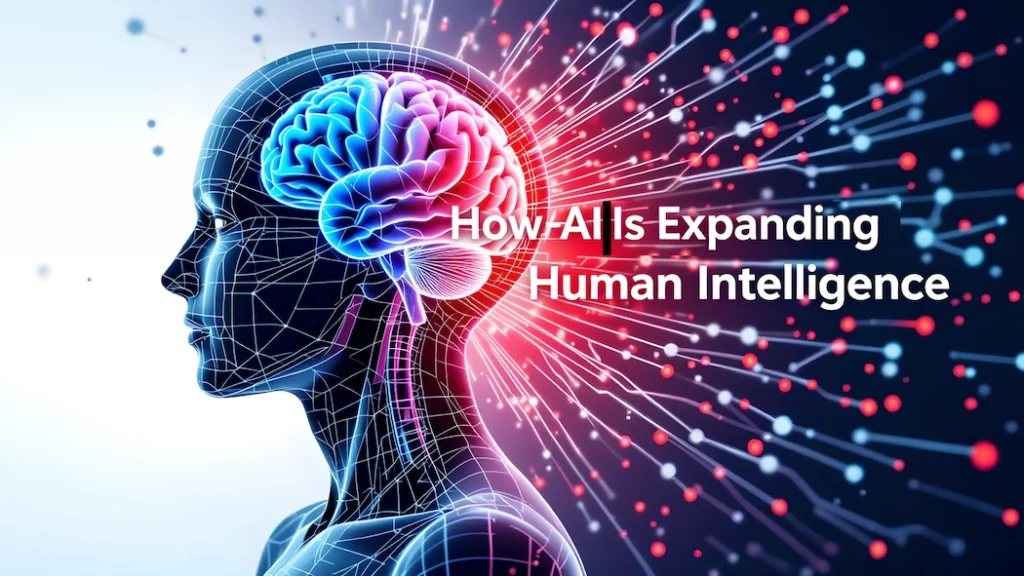
The Quiet Revolution: How AI Is Expanding Human Intelligence
By Gordon Barker | April 2026
A silent transformation is underway. It is not marked by protests, policy announcements, or technological spectacle. It is happening in homes, on laptops, through late-night questions typed into artificial intelligence systems. And for millions of people, it is changing not just how they work — but how they think. The rise of artificial intelligence has often been framed in terms of automation and job displacement, with headlines warning of roles being replaced and industries disrupted. Yet beneath this narrative lies a more subtle and arguably more profound shift: the expansion of individual intellectual capacity.
From Information Access to Cognitive Expansion
For decades, access to knowledge has been mediated by institutions — schools, universities, publishers, and professional environments — where learning required time, resources, and often confidence. Questions left unasked remained unanswered. Artificial intelligence has altered that equation entirely. Today, anyone with access to an AI system can ask complex, nuanced, or even basic questions without fear of judgement, hierarchy, or embarrassment. This is not simply about faster answers. It represents a shift from passive information consumption to active intellectual exploration, where users engage in iterative thinking — asking, refining, challenging, and expanding their understanding in real time. The result is a form of learning that is continuous, adaptive, and deeply personalised.
The End of Intellectual Gatekeeping
Historically, expertise has been protected by layers of access — academic qualifications, professional networks, and institutional authority. While these structures still exist, their role as gatekeepers of knowledge is diminishing. Artificial intelligence does not replace expertise, but it redistributes access to it. Complex subjects — from economics and law to physics and computer science — can now be explored at a level previously inaccessible to non-specialists. This shift carries significant implications for society, particularly for individuals who were excluded from traditional learning environments through circumstance, confidence, or opportunity, and who can now engage with ideas at a much higher level.
The Confidence Gap Closes
One of the least discussed barriers to learning is psychological rather than structural. Many people do not ask questions because they fear appearing uninformed, and this silent constraint limits intellectual growth far more than lack of ability. AI systems remove that barrier entirely. Questions can be asked freely, repeatedly, and without consequence, while misunderstandings can be corrected privately. As a result, individuals who may have disengaged from formal education are now re-engaging with learning on their own terms, reshaping their relationship with knowledge itself.
A New Type of Thinker Emerges
The impact of AI is not uniform and does not automatically make users more intelligent. Instead, it amplifies existing patterns of thinking. Those who approach AI passively, seeking quick answers or shortcuts, may see limited long-term benefit. But those who engage actively, using AI to explore, question, and refine ideas, are developing a new kind of cognitive capability. These individuals are not simply consuming information; they are building mental models, testing assumptions, and accelerating their understanding of complex systems. This marks the emergence of what could be described as the “augmented thinker” — a person whose intellectual capacity is extended through continuous interaction with intelligent systems.
The Risk of Dependency
Despite its benefits, this transformation is not without risk. Reliance on AI without critical thinking can lead to intellectual dependency, where users accept outputs without scrutiny and gradually lose the ability to judge quality or form independent conclusions. The distinction between augmentation and replacement is therefore crucial. AI is most powerful when it supports human reasoning, not when it substitutes for it. Education systems, businesses, and policymakers will need to address this balance carefully if the goal is to develop thinkers rather than passive users of intelligent tools.
Implications for Work and Society
The workplace is already beginning to reflect this shift, with value moving away from routine execution and towards interpretation, judgement, and strategic thinking. In this environment, individuals who can combine experience with AI-assisted analysis are likely to outperform those who rely on either alone. This has the potential to reshape not only career trajectories but also social mobility itself, as the ability to learn independently and continuously becomes one of the most important skills of the coming decade.
A Quiet but Lasting Change
Unlike previous technological revolutions, this transformation is largely invisible. There are no factories being built or physical infrastructures being replaced; instead, the change is internal, occurring within individuals as they rethink how they learn and understand the world. It is a shift from knowledge as something acquired to knowledge as something continuously developed. For some, this represents an opportunity to accelerate beyond traditional limitations. For others, it presents a challenge to adapt. What is clear is that the relationship between humans and knowledge is being rewritten — not by replacing intelligence, but by expanding it. This shift in understanding mirrors how complex systems are interpreted more broadly, including how information and influence move through digital environments, as explored in structural authority flow in search systems.


