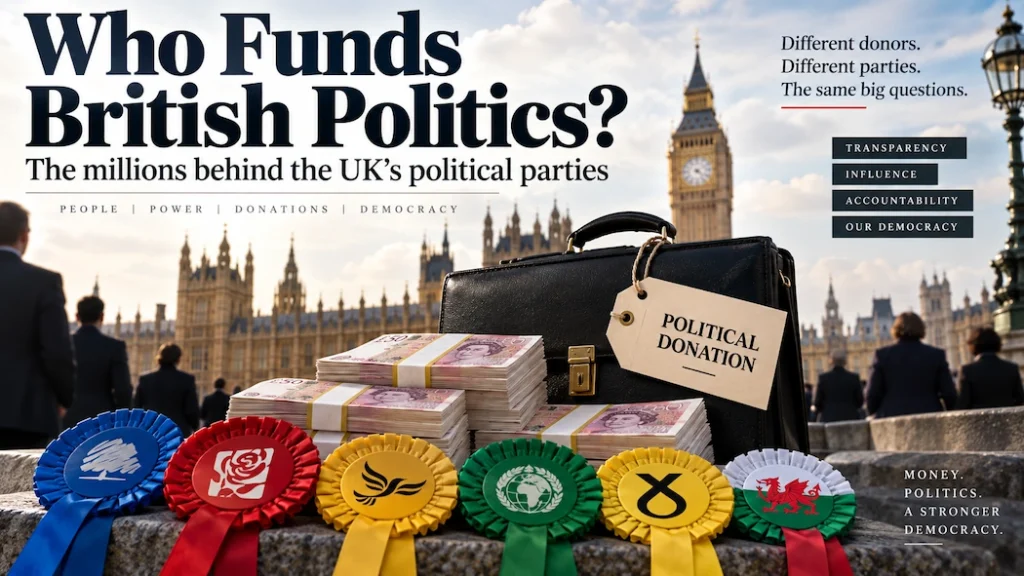
Who Funds British Politics? The Millions Behind the UK’s Political Parties
Author: T.G. Barker 14 September 2026
Political donations are once again attracting attention in Britain. Large individual contributions inevitably generate headlines, particularly when the sums involved appear extraordinary.
But focusing on one donor or one political party risks obscuring a much bigger story.
Political parties need money — and substantial political donations are neither new nor confined to one side of British politics.
For decades, the Conservatives, Labour, Liberal Democrats and other political parties have been financed through different combinations of wealthy individuals, businesses, trade unions, membership subscriptions and other permissible sources.
The more important question is therefore not simply which party has received the latest large donation?
It is:
Who funds British politics, how much money is involved, and what — if anything — should donors reasonably expect in return?
Political Funding Is Big Business
The scale of political funding in Britain has increased considerably.
Electoral Commission figures show that UK political parties accepted more than £93.8 million in donations and public funds during 2023, compared with approximately £52 million during 2022.
Ahead of the 2024 general election the numbers increased dramatically again.
During just three months between April and June 2024, political parties accepted more than £55.5 million.
- Labour accepted approximately £28.5 million during that quarter, including £26.1 million in donations.
- The Conservatives accepted approximately £16.1 million, including £16 million in donations.
- The Liberal Democrats accepted approximately £5.8 million, including £5.3 million in donations.
- The Green Party accepted approximately £293,000.
- The Co-operative Party accepted more than £611,000.
These figures come from the Electoral Commission’s published political donation records.
Political fundraising, in other words, is not an unusual activity occurring on the fringes of British politics.
It is part of the machinery that enables political parties to operate and contest elections.
The Conservative Party and Wealthy Donors
The Conservatives have historically been particularly successful at attracting wealthy individual and business donors.
One of the most striking recent examples was the late businessman John Sainsbury, whose estate donated £10 million to the Conservative Party.
Businessman Mohamed Mansour contributed £5 million.
Healthcare technology entrepreneur Frank Hester and his company also became major Conservative donors, contributing millions of pounds.
The subsequent controversy surrounding comments attributed to Hester demonstrated an important difficulty for political parties.
Receiving a donation that complies with electoral law does not necessarily prevent difficult questions subsequently arising about the donor.
That distinction matters.
A large political donation should not automatically be treated as evidence of improper influence. Equally, political parties accepting very large contributions should expect scrutiny over who is financing them.
Labour Has Its Own Major Donors
Large individual donations are certainly not exclusive to the Conservatives.
Labour has increasingly attracted substantial support from wealthy individuals and businesses as well as retaining its historic financial relationship with trade unions.
Businessman Gary Lubner, former chief executive of Belron, became one of Labour’s significant individual supporters.
David Sainsbury, the former chairman of the Sainsbury’s supermarket group, has donated millions of pounds to political causes and parties over many years, including Labour.
Green-energy businessman Dale Vince and his company Ecotricity have also provided substantial financial support.
Alongside wealthy individuals and businesses sits something fundamentally different: organised labour.
Trade unions have historically contributed millions of pounds to the Labour Party.
That raises an interesting question when proposals for limits on political donations are discussed.
Should £1 million provided by a billionaire be regarded in exactly the same way as £1 million contributed by an organisation representing hundreds of thousands of members?
There is no simple answer.
But it demonstrates why reforming political finance is considerably more complicated than simply placing a maximum figure on a cheque.
The Liberal Democrats Also Attract Wealthy Supporters
The Liberal Democrats operate on a smaller financial scale than Labour and the Conservatives, but substantial private donations have also played an important part in their history.
One fascinating example is David Sainsbury.
Although historically a major Labour supporter, Sainsbury subsequently donated millions of pounds to the Liberal Democrats during Jeremy Corbyn’s leadership of Labour.
Businessman and peer Rumi Verjee is another significant Liberal Democrat benefactor.
This illustrates another overlooked feature of political donations:
Donors sometimes change parties.
Political funding isn’t necessarily a permanent declaration of tribal political loyalty. Wealthy individuals may support different parties at different points because their political priorities — or the parties themselves — change.
What About Britain’s Smaller Parties?
Smaller parties also depend upon donations, although generally on a very different scale.
The Greens, SNP, Plaid Cymru and Northern Irish political parties all report donations and other qualifying funding through the Electoral Commission.
For example, Electoral Commission accounts show that in 2023 the Green Party reported total income of approximately £3.8 million, the SNP approximately £4.75 million, Plaid Cymru approximately £925,000 and Sinn Féin approximately £1.1 million.
These figures should not be confused with donations alone — party income can include membership fees and other sources — but they illustrate an important point.
Running a national political organisation costs money.
Staff must be employed. Offices operate. Research is conducted. Websites and communications systems are maintained. Candidates need support and election campaigns must be organised.
Democratic politics has a financial infrastructure.
Then There Are the Trade Unions
Any serious examination of political funding in Britain also has to consider the trade unions.
Unions including Unite, Unison and GMB have historically provided substantial financial support to Labour.
This represents a different funding model from that of an individual multimillionaire.
A union’s political funds can ultimately represent contributions collected across a very large membership.
Supporters argue that this gives working people collective financial influence capable of counterbalancing wealthy individuals and corporations.
Critics argue that large institutional donations can still provide organisations with political access and influence.
Both arguments deserve examination.
And Membership Matters
There is another funding model that is sometimes forgotten altogether.
Ordinary party members.
During Jeremy Corbyn’s leadership, Labour demonstrated how financially powerful mass membership could become.
Labour’s income reached approximately £55.8 million in 2017, with more than £16 million coming from membership subscriptions.
That represents something fundamentally different from political parties relying heavily upon a relatively small number of wealthy benefactors.
Instead of one person giving £1 million, hundreds of thousands of people might contribute relatively modest amounts.
The financial result can still be enormous.
The £109 Million House of Lords Question
Perhaps one of the most thought-provoking investigations into political donations appeared in 2025.
A Guardian analysis of Electoral Commission records calculated that people who sat in the House of Lords during the previous parliament had given approximately £109 million to political parties, either before or after entering the Lords.
According to the investigation:
- approximately 62% went to the Conservatives;
- approximately 21% went to Labour; and
- approximately 16% went to the Liberal Democrats.
Twenty individuals identified as “super-donors” had contributed more than £1 million each.
You can read the Guardian investigation into £109 million of political donations associated with members of the House of Lords.
This does not establish that peerages were purchased.
That distinction is essential.
But the overlap between very large political donations and appointments to Britain’s legislature creates legitimate questions about political access, influence and public confidence.
Is Giving Money the Problem?
There is an uncomfortable contradiction at the heart of this debate.
We want political parties to exist independently of government.
We want them to campaign.
We want opposition parties capable of challenging governments.
We want candidates capable of communicating with voters.
All of that costs money.
Someone ultimately has to pay for it.
The problem therefore may not be political donations themselves.
The more important issues are transparency, concentration and influence.
Who gave the money?
Where did it originate?
Was the donor legally entitled to give it?
Was the donation properly declared?
And did the donor subsequently receive unusual access, influence, contracts, appointments or political consideration?
Those questions can legitimately be asked irrespective of whether the recipient is Conservative, Labour, Liberal Democrat, Green or any other political party.
Should Britain Limit Political Donations?
Unlike election expenditure, there is no general limit on how much a permissible donor can give to a UK political party.
That creates the possibility of an individual becoming extraordinarily important to a party’s financial position.
Introducing a donation cap sounds straightforward.
In practice, it raises another question immediately:
Where should the limit be set?
£10 million?
£1 million?
£100,000?
£10,000?
And should the same restriction apply to a wealthy individual, a company, a trade union representing hundreds of thousands of workers and a membership organisation?
Political finance reform quickly becomes much more complicated than the headline suggests.
Perhaps the Better Question Is Accountability
Political donations will always generate controversy because money and political power make an uncomfortable combination.
But concentrating criticism on whichever political party happens to receive the largest cheque this week misses the underlying issue.
Britain’s major political parties have all needed substantial amounts of money.
They have simply raised it in different ways.
Some have traditionally relied heavily upon wealthy individuals and businesses.
Others have benefited from trade unions, membership subscriptions and increasingly wealthy private donors.
Smaller parties operate on substantially lower budgets but still require financial support.
The important democratic principle should therefore be consistent.
The same standards of transparency and accountability should apply regardless of which political party receives the money.
The question shouldn’t simply be:
“Who gave them all that money?”
It should be:
“Who funds British politics — and can the public clearly see what happens after the money is given?”
That is a question worth asking of every political party.


