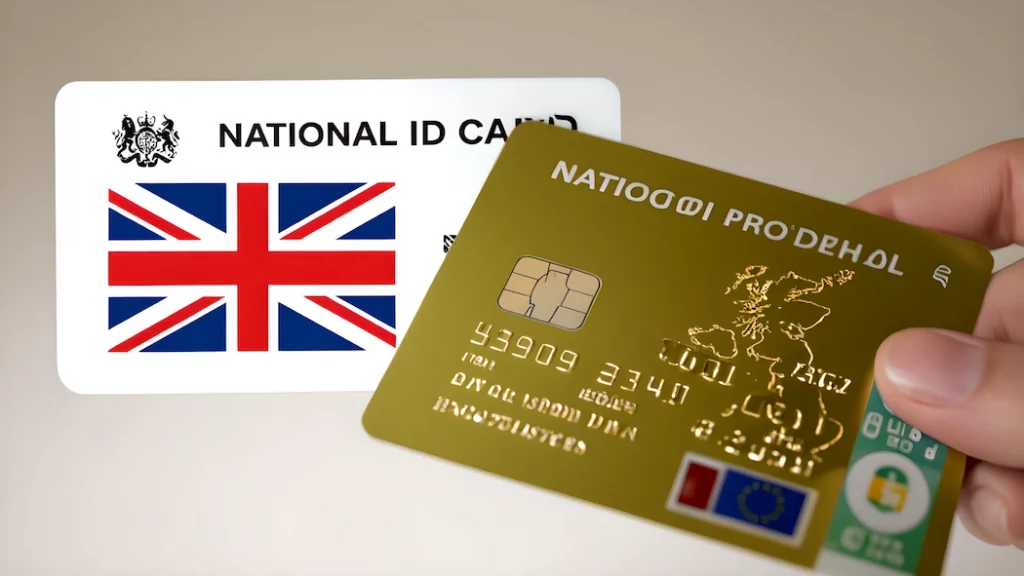
Britain’s Identity Crisis: Why a National ID Card Just Makes Common Sense
We don’t need to invent identity in Britain. We already live inside it — National Insurance, NHS, passports, and licences. The smart move now is to unify, secure, and limit it properly.
Introduction: The False Alarm of the “Nanny State”
Every time the idea of national identity cards re-emerges in Britain, the chorus begins. “Big Brother!” shout the libertarians. “Nanny state!” holler the opinion pages. The rhetoric is reflexive — a political slogan deployed whenever government suggests modernising how we prove who we are. But here’s the awkward truth: the nanny state already exists. If you live here, you already depend on it every time you see a GP, collect benefits, apply for a pension, enrol a child in school, renew a driving licence, or pay taxes. You already exist inside an elaborate web of state-provided welfare and identity systems.
The real question is not whether the UK should “have an ID system.” We already do. The real question is whether it should remain fragmented, inefficient, and insecure — or be unified into a streamlined, secure system that protects freedoms while making life easier for citizens and the state alike.
The Historical Context: Blair’s Fiasco and Cameron’s Bonfire
Britain has walked this path before. In 2006, Tony Blair’s government passed the Identity Cards Act, with a central register and physical ID cards. The plan was sold as modernisation but landed as mission creep. The scheme became a punchline: expensive, intrusive, and unpopular. In 2010, the coalition government repealed it, and ceremonially destroyed the database.
That memory still haunts public debate. For many, “ID cards” conjure images of stop-and-scan policing and overreach. But the world has moved on. Today we prove identity dozens of times a year — to banks, employers, airlines, government portals. We do this not with a single ID, but with many: NI numbers, NHS numbers, passports, licences, utility bills. The problem isn’t absence; it’s fragmentation. Blair’s error was framing: he pitched a brand-new layer of control. What’s needed now is consolidation of what already exists — with hard legal limits.
The Existing Landscape: We Already Have IDs
Every resident already navigates multiple state-issued identifiers. Consider the basics:
- National Insurance (NI): Issued around age 16, used for tax, pensions, and benefits. It’s your working-life anchor.
- NHS Number: A universal patient identifier for prescriptions, referrals, and medical records.
- Passport Number: Held by the vast majority of adults — a gold-standard identity document that’s increasingly required for finance and travel.
- Driving Licence Number: More than 40 million people have one; it doubles as a de facto identity and address check.
These are identity systems in all but name. They connect you to the state and to services. The issue isn’t whether an ID exists; it’s that our IDs are scattered across silos that don’t talk to each other, creating duplication, delay, and needless risk.
The “Nanny State” Myth
“Nanny state” is a reliable headline, but it’s also a distraction. By any honest definition, Britain already runs a nanny state: universal healthcare, social security, state pensions, and compulsory education. This is not a moral judgement; it’s a factual description of the social contract. An ID card doesn’t create that world; it simply recognises and organises it.
If you accept that the state should fund your cancer treatment, pay your pension, insure your jobless period, and educate your children, then being outraged by a unified identity credential looks like selective panic. The grown-up debate is not “ID or no ID,” but “how to design identity so it protects rights, improves access, and reduces friction.”
The Case for a National ID System
1) Efficiency
A single identity that can verify who you are across government reduces bureaucracy, cuts duplication, and shortens waiting times. Think fewer forms, fewer phone calls, fewer “please send another proof of address” emails. For the state, it means cleaner data and lower admin costs.
2) Security
A modern ID can use strong cryptography and biometrics. Done properly, it can be far harder to forge than the current patchwork of documents. The result: less fraud in benefits, safer online access, and fewer bad actors gaming weak links.
3) Inclusion
Millions don’t drive and some don’t hold passports. A universal identity reduces friction for the people who often face it most — the young, the elderly, the disabled, recent arrivals, the homeless. It’s easier to prove who you are if everyone has the same baseline credential.
4) Modernisation
From banking to telemedicine, identity is now the front door. Estonia and Belgium show what’s possible when ID is designed as a service, not a surveillance tool: faster government, fewer queues, better security.
The Hybrid Model: Choice, Not Coercion
Digital exclusion is real. The solution isn’t to abandon reform, it’s to design for it. A hybrid model offers both a smartphone wallet and a physical smartcard:
- Digital ID (free): A gov.uk wallet app using device biometrics (face/fingerprint) with strong encryption. Works across services: Right to Work checks, NHS, DVLA, HMRC.
- Physical Smartcard (£5–10): A chip-and-PIN/contactless card, like a debit card. Stores a cryptographic proof, not your life story. Works offline for basic checks.
People choose what suits them. Those without smartphones aren’t punished. Those who prefer speed get it. And the system stays resilient: if your phone dies, your card still works; if your card is lost, the app still works.
The Cost Question
Issuing secure cards for tens of millions isn’t cheap. But a token fee changes the calculus. £5 per person yields hundreds of millions — enough to cover production and distribution at scale — with exemptions for vulnerable groups. Crucially, a small payment also changes perception: like a passport or licence, it becomes something you own and are responsible for, not a gift you distrust.
The Critics: Civil Liberties and Scope Creep
Privacy advocates are right to demand guardrails. Any serious proposal must include:
- Legal limits: Clear laws that restrict use to defined purposes (e.g., Right to Work, access to services) and explicitly prohibit stop-and-scan policing or fishing expeditions.
- Minimal data: Store proofs, not dossiers. Verification should answer “Is this person who they say they are?” — not expose their history.
- Decentralised design: Use zero-knowledge proofs and signed tokens where possible. Reduce honey-pots, limit attack surfaces.
- Independent oversight: Annual audits, transparency reports, and a statutory watchdog with teeth.
- Redress mechanisms: Fast correction of errors, clear appeal routes, and real-world support for those who get locked out.
These aren’t “nice to haves.” They’re the price of trust. Build them in from the start, and you neutralise the best criticisms while building a system that’s actually fit for purpose.
International Lessons
Estonia pairs a physical card with a robust digital identity, enabling secure voting, banking, prescriptions, and tax filing. The secret isn’t a flashy app; it’s a security-first architecture and relentless transparency. Belgium provides both card and app, letting citizens choose what’s convenient. India’s Aadhaar shows the other side: when a system is over-centralised and rushed, leaks and overreach can erode trust.
The lesson is obvious: the question isn’t whether IDs exist — they do, everywhere. The question is whether we will design ours to empower citizens or to control them. Get the design right, and the benefits compound. Get it wrong, and you fuel the very fears critics warn about.
Political Fault Lines
Westminster’s reactions follow predictable grooves. Modernisers in government frame ID as efficiency, inclusion, and security. Libertarians thunder about state creep. Civil liberties groups demand hard limits. Business wants simpler Right to Work checks but worries about cost and training.
Strip away the tribal noise and a calmer truth appears: the public already proves identity constantly — for banking, tenancy, travel, and healthcare. Most people don’t want more friction; they want less. A well-designed system that gives choice, protects rights, and speeds up life will win quiet consent where ideological sermons fail.
Reframing the Debate
Debate should move from slogan to specification. Here’s a grown-up framing that can command majority support:
- One nation, one identity — but delivered as both app and card.
- Voluntary front-ends — choose phone, card, or both; no smartphone penalty.
- Minimal data, maximum proof — verify without exposing.
- Independent oversight — audits, transparency, and statutory limits.
- Low cost, high trust — token fee for cards; exemptions for those who need it.
This isn’t about building a new state. It’s about cleaning up the one we already have — and doing it with adult safeguards rather than adolescent slogans.
Conclusion: The Fragmented Reality
Britain’s “nanny state” isn’t a looming spectre; it’s the scaffolding of everyday life — from GP surgeries to pension payments, from school enrolments to tax returns. The identity layer within that scaffolding already exists too, just in scattered parts: National Insurance numbers here, NHS numbers there, passport details in another silo, and driving licence data somewhere else. We are already identified, just badly.
So let’s stop pretending that a unified identity is a radical leap. It is, at heart, an administrative housekeeping exercise with constitutional guardrails. Build a hybrid system — app and card — priced fairly, designed securely, and limited by law. Give people choice, protect their rights, and demand transparency. That’s how you modernise a mature democracy without shrinking its freedoms.
Bottom line: we already have IDs — just scattered across NI, NHS, passports and licences; the grown-up move is to unify them and protect our freedoms while we do it.


